
Medicare Medicaid website accessibility is no longer a gray area. If your practice accepts Medicare, Medicaid, or CHIP, your digital platforms are now legally required to meet WCAG 2.1 Level AA — and the first compliance deadline has already passed for practices with 15 or more employees.
Quick Start
If you accept Medicare, Medicaid, or CHIP, here’s what you need to know right now:
- You’re covered by the new HHS ruling. Any organization receiving federal financial assistance must comply with WCAG 2.1 Level AA standards.
- If you have 15+ employees: the May 11, 2026 deadline has already passed. If you haven’t complied, you are out of compliance now. If you have fewer than 15 employees, your deadline is May 10, 2027.
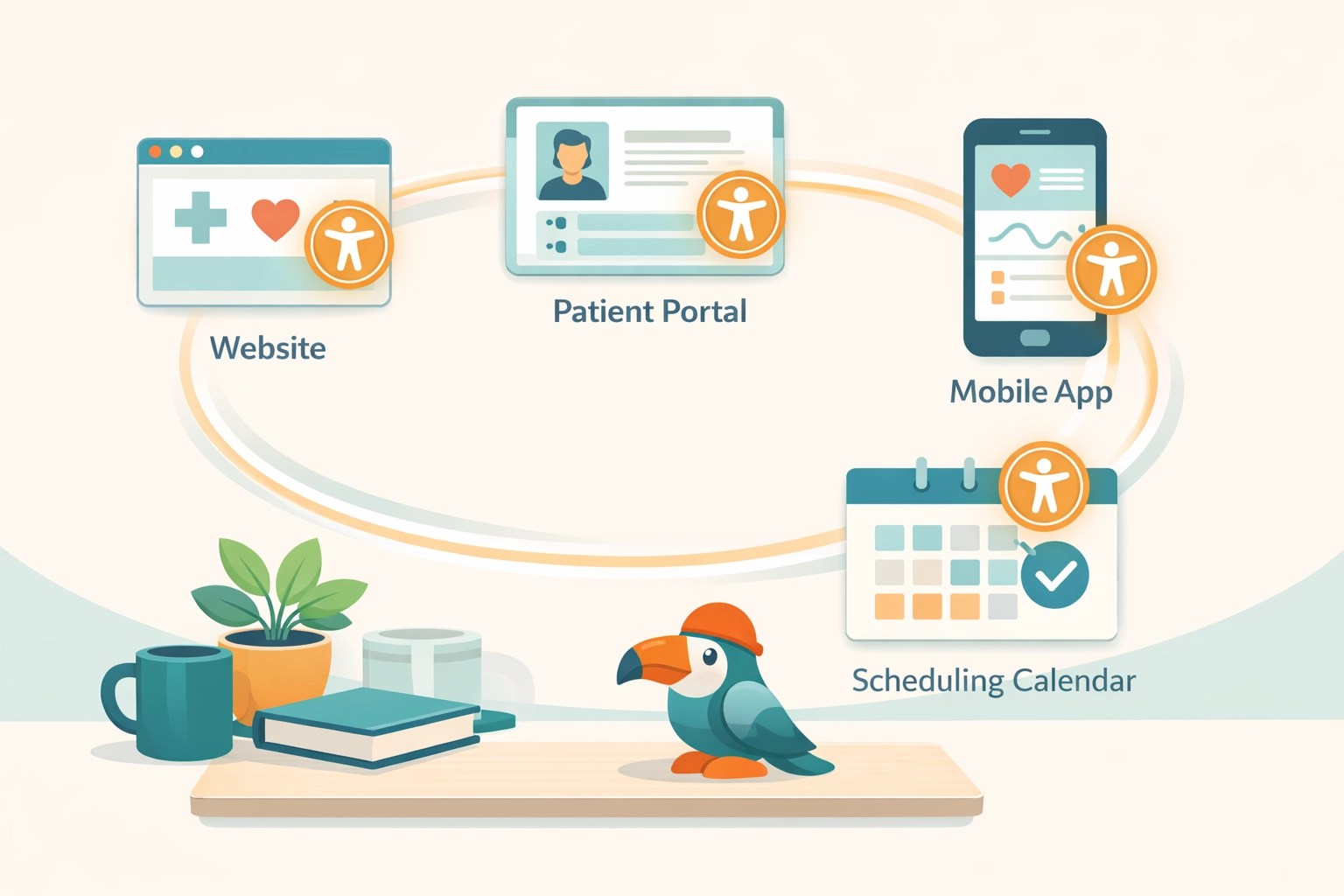
- This isn’t just your main website. Patient portals, appointment schedulers, telehealth platforms, and mobile apps all need to comply.
- Start with an audit. If you missed the first deadline, you need to know exactly where you stand — and document your remediation efforts going forward.
- Overlays won’t save you. Those pop-up “accessibility widgets” create more problems than they solve. Real compliance requires structural changes.
Table of Contents
- What Changed in May 2024
- Does This Actually Apply to Your Practice?
- What WCAG 2.1 Level AA Actually Means
- Your Compliance Timeline
- What Happens If You Don’t Comply
- How to Get Ready (Without Losing Your Mind)
- Your Website Accessibility Checklist
I’ve been building websites for private practices for years, and I can tell you this much: the gray area around Medicare Medicaid website accessibility is officially gone.
In May 2024, the U.S. Department of Health and Human Services published a final rule that changes everything for healthcare providers who accept federal funding. If that’s you, your website is required to meet specific accessibility standards. Not “it would be nice.” Not “if you have time.” It’s the law — and the first enforcement deadline has already passed for larger organizations.
This post will walk you through what the HHS ruling actually says, whether it applies to your practice, and what to do now — whether you’re still ahead of the May 2027 deadline or catching up after May 2026.
What Changed in May 2024
Until recently, healthcare providers operated in murky territory when it came to digital accessibility. The Americans with Disabilities Act (ADA) and Section 504 of the Rehabilitation Act prohibited discrimination against people with disabilities. But they didn’t spell out clear technical standards for websites and apps.
That changed with the new HHS Section 504 final rule.
The rule explicitly requires all recipients of federal financial assistance to make their digital platforms accessible according to Web Content Accessibility Guidelines (WCAG) 2.1 Level AA standards. This includes websites, mobile apps, patient portals, and even kiosks in your office.
Federal financial assistance includes Medicare Parts A, C, and D, Medicaid, the Children’s Health Insurance Program (CHIP), and other HHS-administered programs. If your practice takes any of these, you’re in.
This isn’t about checking a box. It’s about making sure every patient can access your services online, regardless of their abilities.
Does This Actually Apply to Your Practice?
Here’s the straightest answer I can give you: if you accept Medicare, Medicaid, or CHIP payments, yes.
The HHS ruling applies to any organization that receives federal financial assistance. That includes hospitals, health clinics, dental and vision providers, long-term care facilities, and mental health treatment centers. It also includes private practices.
Size doesn’t matter here. Whether you’re a solo practitioner or part of a group practice, if federal funds flow into your business, the rule applies.
And it’s not just your public-facing website. Here’s what else needs to meet WCAG 2.1 Level AA standards:
- Patient portals for scheduling, billing, and records
- Mobile apps for telehealth or appointment management
- Third-party tools like online schedulers, registration forms, and bill pay systems
- Any kiosks or digital check-in systems in your physical office
If a patient interacts with it digitally, it needs to be accessible.
What WCAG 2.1 Level AA Actually Means
WCAG stands for Web Content Accessibility Guidelines. It’s a set of standards developed to ensure that digital content works for people with disabilities. That includes people with vision, hearing, mobility, and cognitive impairments.
WCAG 2.1 (note: version 2.2 exists, but the HHS ruling specifies 2.1) is organized around four principles. I think of them as the foundation of accessible design:
Perceivable: Users need to be able to access your content in different ways. This means adding alt text to images, captions to videos, and ensuring layouts adapt to different screen sizes and assistive technologies.
Operable: Your site needs to work for people using keyboards, voice commands, or other assistive devices. This also means avoiding elements that could trigger seizures, like flashing images.
Understandable: Content should be clear and predictable. Use plain language. Provide helpful error messages on forms. Keep navigation consistent across pages.
Robust: Your site needs to work with current and future assistive technologies like screen readers. This requires clean, standards-compliant code.
WCAG compliance is measured at three levels: A, AA, and AAA. The HHS ruling requires Level AA, which includes critical features like live captions for videos, sufficient color contrast, and resizable text that doesn’t break your layout.
Meeting WCAG 2.1 Level AA isn’t about perfection. It’s about removing barriers so more people can access care.
Your Compliance Timeline
The HHS ruling includes staggered deadlines based on your organization’s size:
- 15 or more employees: May 11, 2026
- Fewer than 15 employees: May 10, 2027
If your organization has 15 or more employees, the May 11, 2026 deadline has passed. As of mid-2026, if you haven’t completed your accessibility remediation, you are currently out of compliance. The HHS Office for Civil Rights has authority to investigate complaints and conduct reviews — that enforcement window is now open.
If you have fewer than 15 employees, your deadline is May 10, 2027 — about eleven months from now. Don’t make the same mistake many larger organizations made. Here’s what I’ve seen building sites over the years: accessibility work takes longer than you think. You’ll need time for an audit, remediation, testing, and training your team. Starting now gives you a real runway to do this properly instead of scrambling.
What Happens If You Don’t Comply
Let’s talk about consequences. The HHS Office for Civil Rights now has clear authority to investigate complaints, conduct compliance reviews, and refer violations to the Department of Justice.
Here’s what that could mean for your practice:
Legal Action: Noncompliance can lead to lawsuits under the ADA and Section 504. Healthcare organizations are already facing legal challenges over inaccessible websites. With the first enforcement deadline now passed for larger practices, that legal exposure is real and present.
Financial Penalties: HHS can suspend or terminate your federal funding. That means losing Medicare and Medicaid reimbursements, grants, and other federal payments. Legal fees and settlement costs can pile up quickly if you’re sued.
Reputational Damage: If your practice is publicly cited for accessibility failures, it affects trust. Patients may choose providers who prioritize inclusive care.
But the bigger issue isn’t penalties. It’s the patients you’re unintentionally excluding. When your website isn’t accessible, people who rely on assistive technologies can’t book appointments, access their records, or get the care they need. That’s the real cost.

How to Get Ready (Without Losing Your Mind)
Whether you’re catching up after the May 2026 deadline or getting ahead of May 2027, reaching WCAG 2.1 Level AA compliance doesn’t have to be overwhelming. Here’s the approach that works:
1. Start with an Accessibility Audit
You need to know where you stand. A website accessibility audit will identify issues on your current site, patient portal, and apps.
Automated tools like Lighthouse, WAVE, and axe DevTools can catch basic problems. But manual testing by someone who understands accessibility is essential. Automated scans miss context, user experience issues, and edge cases.
Don’t forget third-party tools. That scheduling widget, chatbot, or telehealth platform? If patients interact with it, it needs to be accessible too. You’re responsible for ensuring your vendors meet WCAG standards.
2. Prioritize High-Impact Fixes
After your audit, you’ll have a list of issues. Some will be quick wins. Others will require deeper work.
Start with the changes that remove the biggest barriers:
- Add alt text to images
- Ensure keyboard navigation works throughout your site
- Fix color contrast issues
- Add captions and transcripts to videos
- Update forms with clear labels and error messages
- Improve heading structure for screen readers
3. Rebuild with Accessibility in Mind
If your site is old or built on a clunky platform, this might be the moment to start fresh. Trying to retrofit accessibility onto a broken foundation is expensive and frustrating.
When you build with accessibility from the start, it’s faster, cleaner, and easier to maintain. At Transference Studio, we approach every project with WCAG compliance baked in. It’s not an add-on. It’s foundational.
4. Train Your Team
Accessibility isn’t a one-time project. It’s an ongoing practice.
Your content creators, admin staff, and anyone who updates your website need to understand accessible content practices. This includes writing clear alt text, structuring documents properly, and avoiding accessibility pitfalls when adding new pages or posts.
Appoint someone on your team to oversee accessibility. They can field questions, review new content, and keep compliance on track.
5. Set Up Ongoing Monitoring
Your site will evolve. New content, plugins, and updates can introduce accessibility issues. Regular monitoring catches problems before they become complaints or lawsuits.
Use a combination of automated tools and periodic manual reviews. Schedule quarterly checks. Make accessibility part of your standard quality control process.
Your Medicare Medicaid Website Accessibility Checklist
Use this checklist to guide your Medicare Medicaid website accessibility compliance efforts:
- [ ] Determine if your practice receives federal financial assistance (Medicare, Medicaid, CHIP)
- [ ] Confirm your compliance status — 15+ employee organizations are already past the May 2026 deadline; under 15 employees have until May 10, 2027
- [ ] Conduct a full accessibility audit (website, patient portal, apps, third-party tools)
- [ ] Prioritize and remediate high-impact accessibility barriers
- [ ] Add alt text to all images
- [ ] Ensure full keyboard navigation throughout your site
- [ ] Fix color contrast issues to meet WCAG AA standards
- [ ] Add captions and transcripts to all video content
- [ ] Update forms with clear labels, instructions, and error messages
- [ ] Review and improve heading structure for screen readers
- [ ] Test your site with assistive technologies (screen readers, magnifiers, voice control)
- [ ] Train your team on accessible content practices
- [ ] Assign an accessibility lead within your organization
- [ ] Set up ongoing monitoring and testing processes
- [ ] Document your accessibility efforts and policies
- [ ] Review third-party vendor contracts for WCAG compliance
- [ ] Remove any accessibility overlays (they don’t count as compliance)
The HHS ruling on Medicare Medicaid website accessibility isn’t going away. For practices with 15 or more employees, the first deadline has passed — which means enforcement is now in play. The standards are clear, and the consequences of ignoring them are real. Documenting your remediation efforts and acting in good faith now can matter significantly in how any enforcement review unfolds.
But this isn’t just about avoiding penalties. It’s about building a practice that serves everyone who needs care. When your digital platforms are accessible, more patients can reach you. Your intake process gets smoother. Trust increases. And you’re doing the right thing.
If you’re not sure where your site stands or what needs to change, now’s the time to find out. We can run a website accessibility audit and walk you through exactly what needs to change — and if the May 2026 deadline has already passed for you, how to catch up and document your compliance efforts.
Want help building a site that’s accessible from the ground up? Let’s talk. We specialize in websites for private practices that prioritize clarity, compliance, and client care.