Building Trust on a Therapist Website Without Client Testimonials
Soliciting client reviews is often a direct violation of your ethics code, whether you follow APA, ACA, or NASW guidelines. Here’s how to build deep, lasting website trust using credentials, transparency, and process, without a single client quote.
Client testimonials carry real ethical risk in private practice: power imbalance and confidentiality exposure. You can build just as much trust, arguably more, through visible credentials, a clear “What to Expect” process, educational content, and colleague endorsements, none of which put a client’s privacy at risk.
Key takeaways
- Testimonials carry a real power imbalance. A client may feel pressured to leave a positive review, and even a voluntary one creates a confidentiality risk.
- Clinical transparency replaces social proof. Visible licenses, specialized certifications, and professional memberships all signal legitimacy without a client’s involvement.
- A clear process lowers anxiety. Describing exactly what happens from consultation call to ongoing sessions builds trust through predictability.
- Educational content lets clients “test drive” your perspective. A well-written blog post demonstrates expertise in real time, with zero privacy risk.
- Colleague endorsements are the ethical alternative to reviews. Since there’s no power imbalance between you and a fellow professional, these are generally safe to use.
You just finished looking at a competitor’s website. They have a slider of glowing five-star reviews from “Sarah M.” and “John D.” talking about how life-changing their sessions were. You feel a familiar pang of frustration. As a therapist, you know that soliciting those reviews is often a direct violation of your ethics code. Whether you follow APA, ACA, or NASW guidelines, the rules are usually clear. Client testimonials are a minefield of power imbalances and confidentiality risks.
This puts you in a tough spot. In almost every other industry, reviews are the lifeblood of trust. People don’t buy a toaster or book a hotel without checking the ratings first. When someone is looking for a therapist, the stakes are even higher. They are looking for a place to bring their trauma, their neurodivergence, and their most vulnerable thoughts. They need to know they can trust you.
But you can build deep, lasting therapist website trust without a single client quote. In fact, for many prospective clients, a website that prioritizes professional integrity over marketing gimmicks is actually more reassuring. You just need to know which trust signals to use instead. This post will show you how to demonstrate your expertise and warmth while staying fully inside your ethical boundaries.
The problem with testimonials in private practice
Most private practice owners understand that reviews are tricky. The core issue is the power dynamic. A client might feel pressured to provide a positive review because they value the relationship with their therapist. They might even think a “bad” review would hurt their own treatment. This is why many ethics boards classify soliciting testimonials as potentially exploitative.
Even if a client offers a review voluntarily, there is the issue of confidentiality. Posting a testimonial confirms that a specific person was in treatment with you. Even if they use a pseudonym or initials, it’s a risk. If you are a neurodiversity-affirming practitioner, your clients may already face systemic barriers. Adding a digital paper trail to their mental health journey isn’t always in their best interest.
The good news is that prospective clients are smarter than most marketers think. They know that therapy is private. When they see a website full of “Patient Testimonials,” a small part of their brain might actually feel more hesitant. They might wonder if their own story will end up on the internet. By intentionally choosing not to use testimonials, you are already signaling a high level of respect for client privacy.
Establishing trust through clinical transparency
If you can’t show that other people liked working with you, you have to show that you know what you’re doing. This starts with clinical transparency. A prospective client wants to know that you are a legitimate professional with the right training for their specific needs.
Licenses and credentials
Don’t bury your credentials on a tiny line at the bottom of the page. Clearly state your license type, your degree, and your license number. If you are licensed in multiple states for telehealth, list those clearly. This isn’t just about showing off your hard work. It’s about providing the information a client needs to verify your standing with the state board.
Specialized certifications
If you have advanced training in specific modalities, show the badges. Whether it’s EMDRIA certification for trauma or specialized training for supporting autistic adults, these visual markers build therapist website trust quickly. They tell the reader that you have gone beyond the basics to master the tools they need.
Professional memberships
Are you a member of the APA, the World Professional Association for Transgender Health (WPATH), or a local neurodiversity collective? Listing these memberships shows that you are connected to a larger professional community. It suggests that you stay up to date with current research and ethical standards.
The power of a process-driven website
One of the biggest hurdles to trust is the “unknown.” A prospective client is often nervous about what that first session will actually feel like. You can build trust by removing the mystery. Instead of vague promises of “growth,” tell them exactly what happens after they click the contact button.
Create a “How I Work” or “What to Expect” section. Use simple, direct language to describe the journey: the initial consultation call, the intake paperwork and how you protect their data, the first session goals, and the typical rhythm of ongoing therapy.
When you describe your process, you are demonstrating that you are organized and reliable. This is especially important for neurodivergent clients who may feel significant anxiety about new social situations. By providing a clear roadmap, you are lowering the barrier to entry and building trust through predictability.
Identity and shared values
For many clients, trust is built on shared identity and values. This is where your website design and copy do the heavy lifting. If you are a culturally responsive therapist, your website should reflect that through its imagery and the way you talk about systemic issues.
Inclusive design is a massive trust signal. If your website is accessible to people using screen readers or those with sensory processing differences, you are proving that you care about their experience before they even meet you. At Transference Studio, we focus on neurodiversity-affirming website design because we know that accessibility is a form of care. A website that is easy to navigate and easy on the eyes tells a client that you have considered their needs.
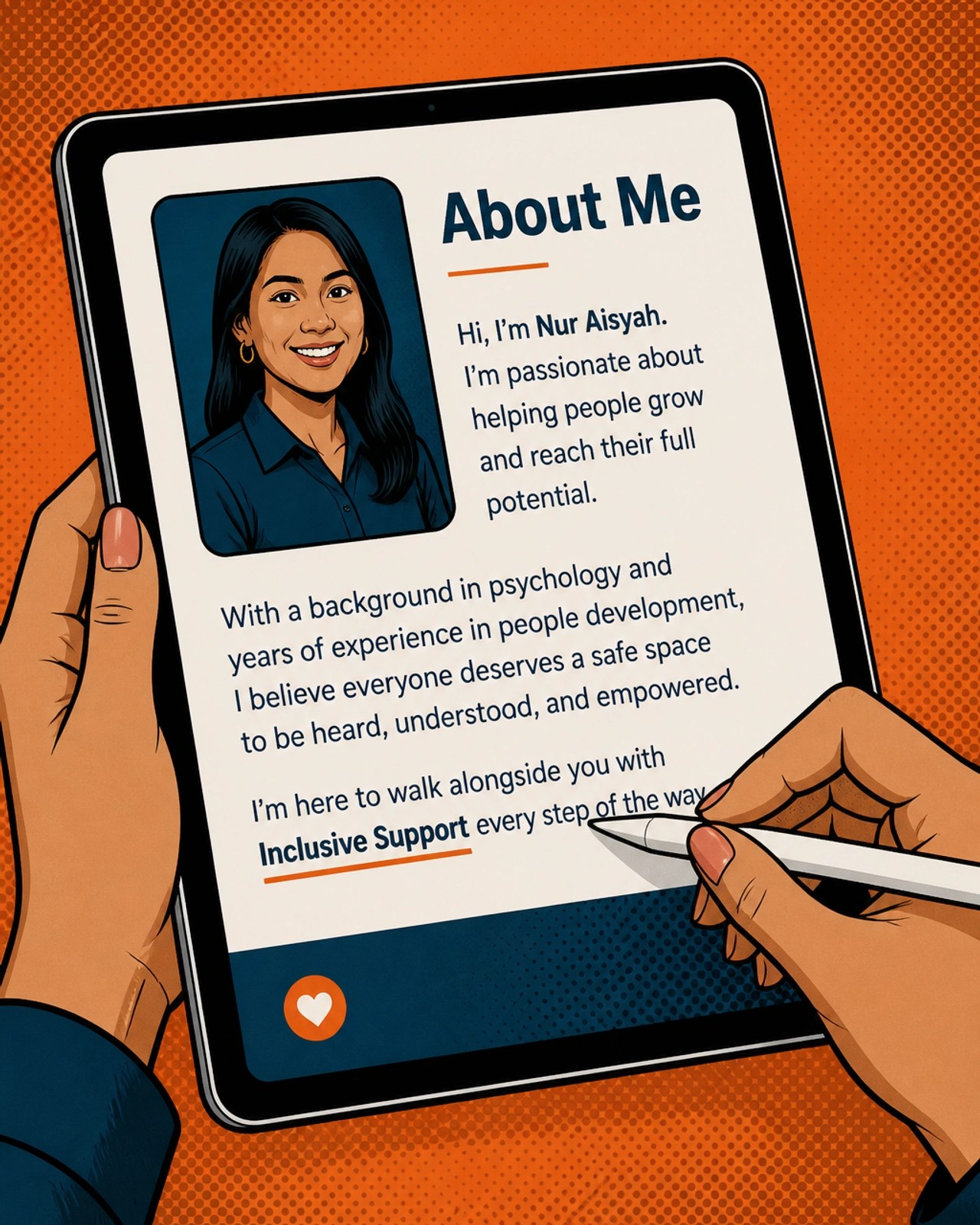
Your “About” page is also a critical tool for building credibility. Instead of a dry resume, use it to explain why you do this work. Talk about your philosophy. If you identify as a neurodivergent clinician, sharing that, if you feel comfortable, can create an instant bond of trust that no anonymous testimonial ever could.
If you are unsure how to structure your own story, read our guide on what to put on your about page for examples and a clear framework.
Educational content as proof of expertise
Another way to build therapist website trust is to give away your knowledge. When you write blog posts or create resources that help people understand their own mental health, you are demonstrating your expertise in real-time.
A well-written article on “How to Manage ADHD Burnout” or “Understanding Attachment Styles in Queer Relationships” shows that you understand the nuances of your niche. It allows a prospective client to “test drive” your perspective. They can see how you think and how you talk about difficult topics. If they find your written words helpful and compassionate, they are much more likely to trust you with their actual life stories.
This approach is far more ethical and effective than testimonials. You are providing value upfront without asking a client to compromise their privacy. You are building authority by being a helpful resource.
Colleague endorsements: the ethical social proof
While you should not ask clients for reviews, you can absolutely ask colleagues for endorsements. A professional endorsement is a statement from another professional who can speak to your skills, your reliability, and your clinical focus.
You might have a section on your site titled “What Colleagues Say” or “Professional Referrals.” These quotes from doctors, fellow therapists, or community leaders carry significant weight. They tell prospective clients that you are respected within your field. Since there is no power imbalance between you and a colleague, these endorsements are generally considered ethical and safe to use.
Transparency in logistics
Nothing breaks trust faster than hidden fees or confusing billing practices. To build therapist website trust, be incredibly clear about the “boring” stuff: list your session fees clearly, explain your insurance or out-of-network policy, detail your cancellation policy, and explain your telehealth platform and how it stays HIPAA compliant.
When you are transparent about the business side of your practice, you are showing that you have nothing to hide. It demonstrates a level of professional integrity that makes clients feel safe. They won’t have to worry about an unexpected bill or a technical glitch during a session.
A note on third-party review sites
You might find that clients leave reviews for you on Google or Yelp without you asking. This can feel like a gray area. While you can’t always control what people post online, you can control how you respond. Most experts suggest not responding to these reviews at all. Responding can inadvertently confirm that the person is a client, which is a HIPAA violation.
Instead of worrying about those external sites, focus on making your own website the ultimate source of truth. When your site is professional, accessible, and full of clear information, those random Google reviews will matter much less.
Trust isn’t something you can buy with a handful of five-star ratings. It is something you build through consistency, transparency, and ethical behavior. By focusing on your credentials, your process, and your values, you create a website that feels like a safe harbor. Your website is often the very first interaction a client has with you. If that interaction is built on clear communication and a deep respect for their privacy, you have already started the therapeutic work. You don’t need testimonials to prove you are a great therapist. You just need to show up authentically and professionally in your digital space.
Your trust audit checklist
Ready to build a website that earns trust?
Through inclusive and accessible design, not client testimonials.
Start the Conversation