
Veterinary Website Design: 9 Features Every Clinic Site Needs
It is 6pm on a Tuesday. A pet owner is standing in their kitchen with a cat that has been sneezing for three hours. They pull out their phone and search for a vet nearby. If your website is the one that comes up, you have three seconds to show them you can help and that you are easy to reach.
A veterinary website is not a digital brochure. It is a functional tool that helps stressed pet owners make a decision quickly. These nine features determine whether a visitor books an appointment or keeps scrolling: accessibility, online booking, mobile-first design, emergency information, staff bios, new client onboarding, local SEO, transparent service pages, and sensory-friendly visuals.
Key takeaways
- Accessibility is the highest-leverage feature on any vet website. If a client cannot navigate your site due to low vision, cognitive differences, or motor impairments, none of your other features can help them book.
- Stressed pet owners decide in seconds. Your contact number, hours, and emergency information must be findable without scrolling on a phone screen. If a parent cannot find it fast, they pick the next result.
- An online booking button on every page removes the biggest conversion barrier. People search for vets after hours. If calling the front desk is the only option, most of those visits are lost.
- Staff bios with real photos convert better than credentials alone. When a client sees a team member who reflects their community or their values, the decision to book becomes easier and more confident.
- Local SEO and Google Business Profile are what get you seen. A well-designed website that does not show up in local search is invisible to the people who need you right now.
Most veterinary website design focuses on cute puppy photos. While everyone loves a golden retriever, a pretty picture does not help a stressed client find your phone number at 10pm. In 2026, an effective vet clinic website is a functional tool that supports both your staff and your clients. Here are the nine features that separate a high-performing clinic site from a digital brochure.
Universal Design and Accessibility
Accessibility is not a legal box to check. It is the most important foundation for a veterinary website because pet owners span every age, ability level, and sensory profile. Many of the people bringing their animals to you navigate the world with low vision, dyslexia, ADHD, or motor impairments that make traditional web design frustrating or unusable.
Following the Web Content Accessibility Guidelines (WCAG) 2.1 Level AA means using high-contrast text and backgrounds, clear heading structure, descriptive alt text on all images, and keyboard-accessible navigation. It means your booking button works with a keyboard, not just a mouse. It means your emergency number is coded as real text, not buried in an image file that a screen reader cannot read. See our guide on simplifying your healthcare website for the design principles that make accessibility and aesthetics work together.
When you build for the edges of your user population, you make a better experience for everyone. The pet owner checking your site on a cracked phone screen in a parking lot benefits from the same high-contrast design choices that serve a low-vision user. Accessibility and usability are the same investment.
Online Appointment Scheduling
Your clients do not always think about vet visits during your business hours. They think about them at midnight when they finally sit down on the couch and notice their dog has been scratching more than usual. If the only way to book an appointment is to call your front desk, you are creating a barrier that most people will not overcome outside of a genuine emergency.
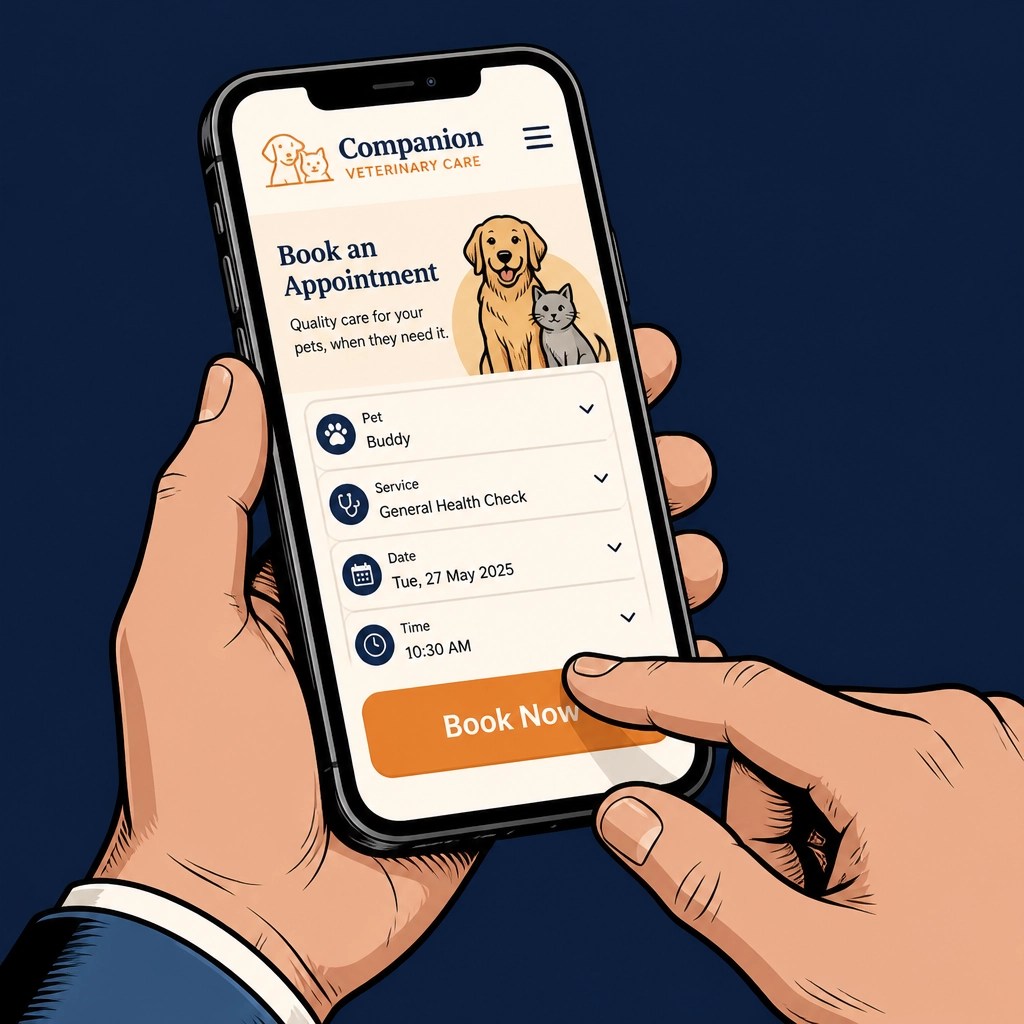
Integrate your practice management software directly into your site. A clear “Book Now” button should appear in your header and repeat on every service page. If a visitor cannot find a way to book in under five seconds without scrolling, you are losing that appointment. The goal is zero friction between the decision to book and the completed booking.
Mobile-First Responsiveness
Most of your website traffic comes from a smartphone. This is not a trend. It is the permanent reality of how people search for local services. If your veterinary website looks polished on a desktop but breaks or becomes slow on a phone, you are losing the majority of your potential new clients before they ever read a word.
Mobile-first design means buttons are large enough to tap with a thumb without accidentally hitting the wrong element. Text is readable without pinching and zooming. Your phone number is coded as a clickable link so a tap dials immediately. Photos compress and load quickly even on a weaker data connection. These are not luxuries. They are the baseline expectations of anyone searching for a vet from their phone in a stressful moment.
Emergency Triage Information
When a pet is in crisis, the owner is not in a state of mind to hunt through a Services menu. They need to know what to do in under five seconds. Your website needs to make that possible.
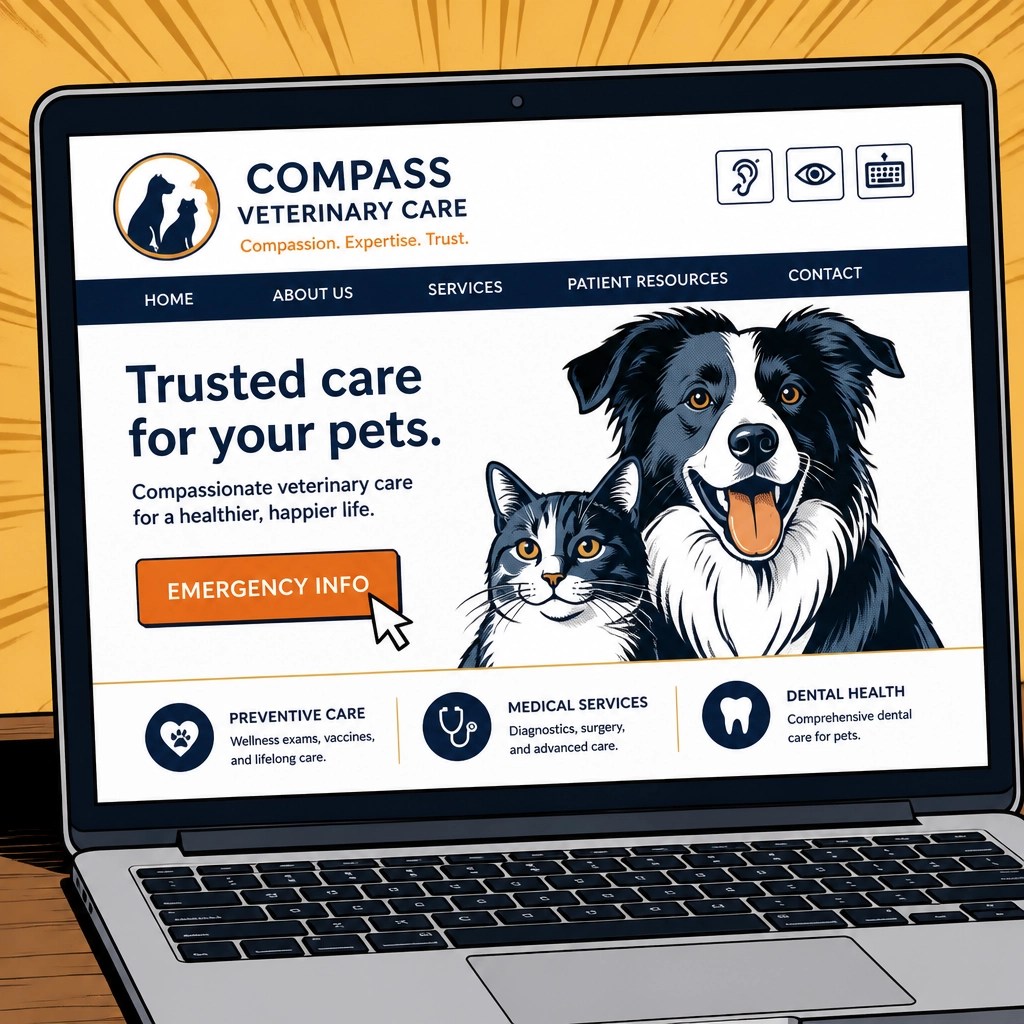
Your emergency section should be linked in the main navigation and, ideally, featured as a persistent banner or sticky element at the top of every page. Include your emergency phone number, your hours for urgent cases, and a direct link to the nearest 24-hour emergency animal hospital if you are not a 24-hour facility. This builds deep trust with your community. Pet owners remember which clinics made them feel prepared in a frightening moment.
Your emergency phone number should be the first visible element on your mobile homepage. Test this right now by pulling up your site on a phone and asking: can I find the emergency number in under three seconds without scrolling?
Staff Bios and Team Representation
People do not just pick a clinic. They pick a team. Your About or Team page is consistently one of the most visited pages on a veterinary website, often ranking behind only the homepage and the appointment booking page. Move beyond a list of degrees and certifications.

Show your team’s personality. Include photos of staff with their own pets where they are willing. Make sure your team photos represent a diverse range of people: different ages, backgrounds, and life experiences. When a client sees someone on your team who shares their background or their values, the decision to book becomes easier. Representation matters in veterinary medicine just as much as it does in human healthcare. A homogeneous team photo sends a quiet signal about who your clinic is really for.
New Client Onboarding
The first visit is the highest-friction point in the client relationship. You can dramatically reduce that friction by putting your new client materials online and making the process as clear as possible before the visit happens.
Do not make new clients print out a PDF and bring it to the appointment. Use digital intake forms that can be completed on a phone or tablet before the visit. Keep the forms as short as possible and only ask for what you genuinely need for that first appointment. A longer form does not communicate thoroughness to a new client. It communicates friction.
Your New Client page should walk through exactly what to expect: where to park, what to bring, how the check-in process works, and how long a first visit typically takes. A neurodiversity-affirming approach means reducing the cognitive load and the uncertainty at every step. The easier you make it to join your practice, the more likely people are to complete the process rather than abandoning it mid-form.
Local SEO, Service Pages, and Sensory-Friendly Visuals
If you want to be found, you need to show up where people are searching. For veterinary clinics, that means the Map Pack on Google, the top three local results that appear in response to searches like “vet near me” or “animal hospital in [city].” Your website needs to support your local SEO strategy, which starts with local SEO fundamentals and a fully optimized Google Business Profile.
Your website’s contribution to local SEO includes: a dedicated Contact page with an embedded Google Map, consistent NAP (Name, Address, Phone) across your website and all directories, individual service pages for your core offerings (dental care, wellness exams, surgery, exotic pets), and content written in plain language that answers the questions pet owners actually search for.
Visuals also carry strategic weight. If you run a fear-free or cat-friendly practice, show it in your photography. Use images that highlight a calm, clean, quiet environment. Avoid auto-playing videos or animations on load. These are overwhelming for users with sensory sensitivities, including many neurodivergent clients, and they also slow page load times significantly. Clean, professional imagery that reflects the warmth of your actual practice converts better than high-production stock photography. For a complete digital visibility strategy, read our guide to veterinary SEO.
Your Veterinary Website Audit Checklist
Use this checklist to audit your current site or brief a developer on what to build. Each item maps to one of the nine features above.
Ready to make your clinic’s website as welcoming as your waiting room?
We design veterinary and healthcare websites that convert stressed pet owners into loyal clients, built on universal design principles from day one. Most of our work is with private practice therapists. See our approach to website design for therapists.
Start the Conversation