
How to Get More Google Reviews for Doctors, Dentists & Vets
Most happy patients leave your office smiling and never leave a review. The one person with a billing complaint went straight to their keyboard. This guide covers the ethical, HIPAA-aware system for closing that gap before it defines your rating.
Google reviews are the primary trust signal for local healthcare. Happy patients stay silent by default. A HIPAA-aware review system built around the right timing, a simple staff script, and automated follow-up is the most reliable way to close the gap between the care you provide and the rating you show online.
Key takeaways
- Happy patients stay silent by default. A systematic ask at the right moment is the only reliable way to convert positive patient sentiment into public ratings that new patients actually see.
- HIPAA prohibits confirming patient status in your public response. Even if a patient names their exact procedure in a glowing review, you cannot acknowledge they were ever in your office. Your response templates need to be written with this constraint built in from the start.
- Timing the ask is a clinical skill. The Peak-End Rule from psychology predicts that people remember the peak of an experience and the end. The checkout moment after a positive visit is when conversion is highest. Training your team to recognize that window is the highest-leverage action you can take.
- Never incentivize reviews. The FTC and Google both prohibit review gating and incentivized reviews. A small number of 3- or 4-star reviews among 5-stars actually increases credibility. A perfect 5.0 with hundreds of reviews raises suspicion.
- Your review strategy should run without you remembering to act. Build automation into your patient journey so that follow-up is triggered by checkout, not by someone on your team remembering to ask.
You check your Google Business Profile and see a 3.2 rating. It feels like a gut punch because you know the care you provide is exceptional. Most of your patients leave smiling. They thank you. They book their next appointment. But they do not leave a review. Managing Google reviews for doctors, dentists, and vets is one of the highest-return activities in your entire marketing strategy, and almost no practice has a system for it.
Google Reviews as the Primary Healthcare Trust Signal
Google reviews are the first thing a prospective patient checks, often before they read your About page or visit your website at all. In local search, the Map Pack (the three practices shown at the top of a location-based search) is heavily influenced by review volume, star rating, and recency. If your profile is stagnant or weighted toward negative reviews, you are losing referrals before your phone ever rings.
In healthcare, the silence of a happy patient is a marketing problem. Most people only think to leave a review when something goes wrong. When something goes right, they go home and get back to their lives. Building a system to capture that positive sentiment without crossing ethical lines or violating privacy laws is the entire challenge this guide addresses.
For a complete local search strategy that connects your review presence to your broader online visibility, see our guide to local SEO for healthcare practices.
The HIPAA Constraint: What You Can and Cannot Do
Before you build any review system, you must understand the unique compliance constraints of healthcare. Unlike a coffee shop or a plumber, you cannot simply reply to a patient review and confirm the person was ever in your office.
Even if a patient leaves a detailed five-star review mentioning their specific surgery, the name of their medication, or the nature of their diagnosis, you cannot acknowledge those details in your public response. Confirming they are a patient, and confirming the health information they mentioned, constitutes a disclosure of Protected Health Information (PHI) under HIPAA. The fact that they chose to share their own health information publicly does not give you permission to echo it back.
This is why many doctors and dentists feel paralyzed when managing their online reputation. They are afraid of saying something that triggers a HIPAA violation. The solution is not to avoid engagement. The solution is a standardized, compliant response template that treats every review the same way, regardless of what the patient shared.
Your HIPAA response obligation applies to every public-facing platform where patients mention their care: Google, Yelp, Healthgrades, Facebook, and Zocdoc. Any platform where you can reply publicly requires the same compliance discipline as your Google responses.
Claiming and Optimizing Your Google Business Profile
You cannot collect reviews if patients cannot find you. Many practices have “zombie” profiles: listings created automatically by Google from public data, unmanaged, with wrong hours, outdated phone numbers, and no photos. Claim yours before someone else does.
Once claimed, verify that your Name, Address, and Phone number (NAP) are exactly the same on your Google Business Profile as they appear on your website and top specialty directories. If your website says “Suite 100” but Google says “Unit 100,” that inconsistency quietly hurts your local search ranking and reduces AI search citation confidence.
Add high-quality photos of your office, your waiting room, and your team. In healthcare, the unknown generates anxiety. Seeing the reception area and the faces of the staff lowers the psychological barrier for a new patient who is already anxious about seeking care. A completed, photo-rich GBP profile converts at significantly higher rates than an empty one.
The Peak-End Rule: Timing Your Ask for Maximum Conversion
Psychology research on memory and experience, notably the work of Daniel Kahneman, shows that people remember two moments from any experience: the peak (the most intense moment) and the end. For a medical or dental visit, the end is usually the checkout moment. This is when conversion is highest.
If you wait two days to send a follow-up email, the emotional connection to the visit has faded. The patient is back to their daily life. The gratitude is gone. But if you ask when they are standing at the front desk, relieved the appointment is over and went well, you are catching them at the exact moment their positive feeling is most vivid and most shareable.
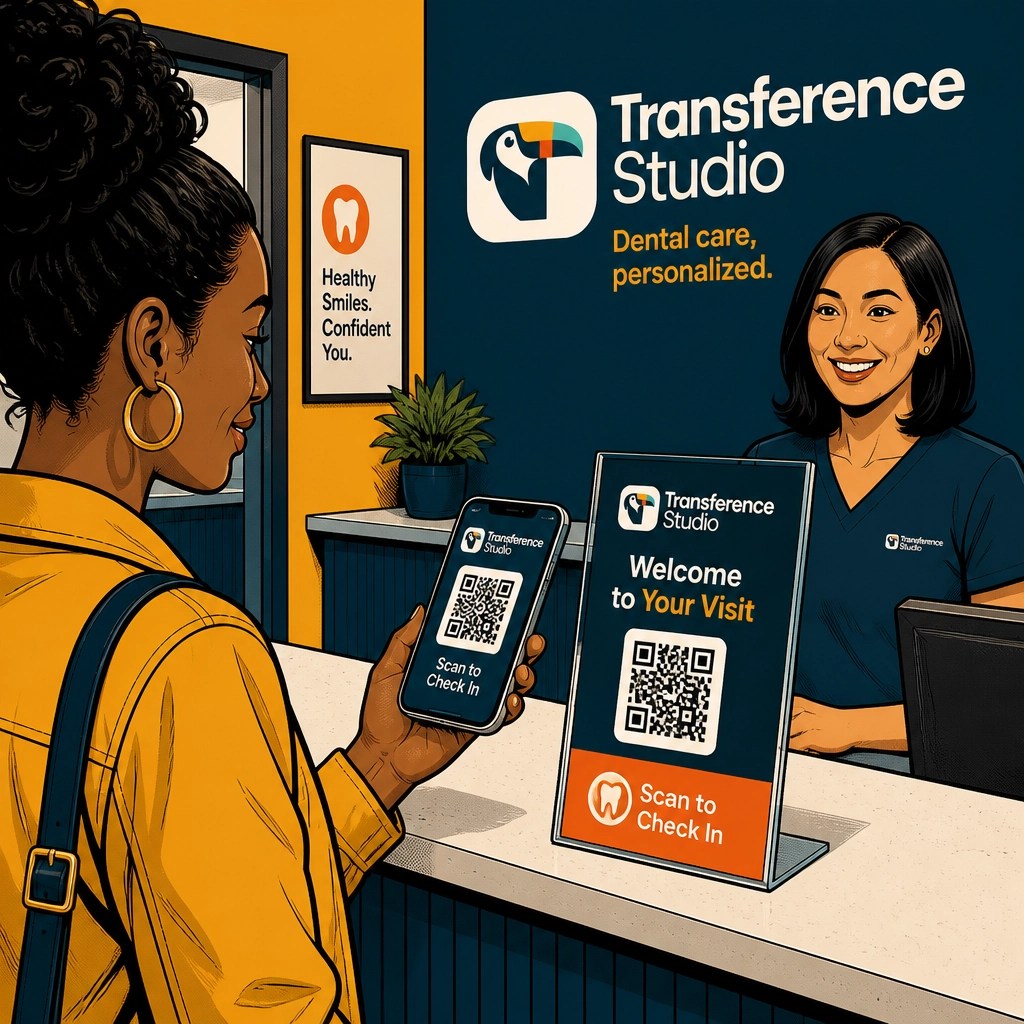
Training your staff to recognize this moment is the highest-leverage action in your entire review strategy. When a patient says “Thank you so much, I feel so much better,” that is the natural opening. That is the peak-end moment.
Scripting the Conversation for Your Team
Your front desk staff may feel awkward asking for reviews. They do not want to sound like they are selling something. The key is a script that frames the request as a service to the community rather than a favor to the practice.
A script like this works well: “We are really glad your visit went well today. If you have a moment, would you mind sharing your experience on Google? It really helps other families in our community find us when they are looking for care.” The phrase “other families” or “other people in our community” shifts the ask from commercial to civic. Most people are genuinely happy to help others who are in the position they were in an hour ago.
Pair the verbal script with a physical QR code card at the checkout desk. Make it as frictionless as possible. The fewer steps between the patient’s intention to leave a review and the published review, the higher your conversion rate.
Automation and Practice Management Tools
Manually asking every patient is not sustainable. The best review system is one that runs in the background as part of your standard patient journey. Many practice management systems, including Tebra, Dentrix, and Jane App, have built-in SMS and email follow-up tools that can trigger a review request automatically after checkout.
If you use a third-party reputation management platform like Birdeye or Podium, confirm that a Business Associate Agreement (BAA) is in place before sharing any patient contact information with that platform. Because patient contact details (name, phone number, email) are themselves PHI in the context of a healthcare relationship, any vendor that receives them must be HIPAA compliant and must sign a BAA.
A simple text message sent 30 minutes after a positive appointment, with a direct link to your Google review page, is the most effective automated follow-up. It removes every step between the intention and the action. The patient does not need to search for your practice name. They tap once and type.
Responding to Reviews: HIPAA-Safe Templates That Work
Respond to every review. A practice that responds shows it is listening. It also signals to the thousands of prospective patients reading those reviews that your team is engaged and professional. You should have templates ready for each response type.
For positive reviews, keep your response general: “Thank you for sharing your feedback. We work hard to provide high-quality care to everyone who visits our practice and are so glad to hear your experience reflected that.” Notice this response does not confirm the person was ever a patient. It states a general practice philosophy. That is HIPAA-safe.
For negative reviews, never argue and never get defensive. The goal of a response to a critical review is not to win the argument with the unhappy person. It is to show the thousands of prospective patients reading that review that you are professional and take concerns seriously. Use a template like: “Thank you for bringing this to our attention. We take all feedback seriously as we work to provide excellent care. Because we respect patient privacy, we are unable to discuss details publicly. Please contact our office manager at [Phone Number] so we can address your concerns directly.” Move the conversation offline immediately.

For veterinary practices: while HIPAA technically governs human health records rather than animal records, the same privacy principles build trust with pet owners. Following the same response discipline signals that you are a professional medical facility, not a retail service, and pet owners notice.
If you operate an animal hospital, our guide to veterinary SEO covers the full digital strategy for vet clinics.
Your Review System Setup Checklist
These eight steps build a review system that runs in the background and compounds over time. Most take under 20 minutes to complete.
Ready to build a review system that actually works for your practice?
We help healthcare and private practice websites turn their clinical reputation into visible social proof, without compromising compliance.
Start the Conversation